

The AI Bubble, Part III
The Bubble That Didn’t Pop (So It Changed the Rules)
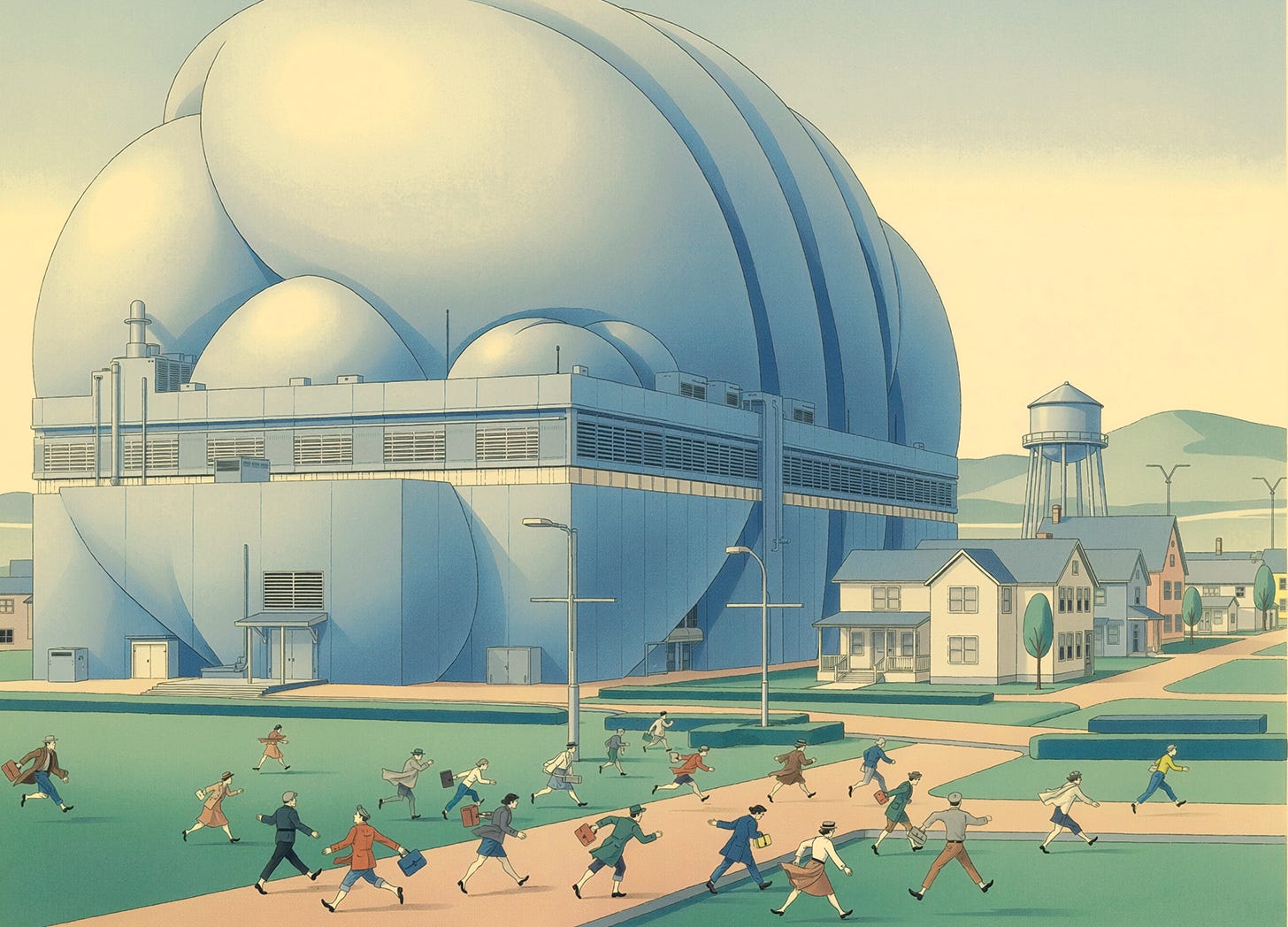
By Riggs D. Thermonucleon, Professor Emeritus of Unearned Credentials, EBITDA, YoY, NFW
Editor’s Note
If you’re joining us mid-experiment, this piece is Part III in our ongoing look at the so-called “AI bubble”—a term that has proven to be both useful and, increasingly, insufficient.For context, in January of this year, we started our deep dive:
In Part I, we explored the idea that AI valuations were being driven less by current performance and more by expectations of future dominance—what happens when belief gets priced before reality arrives.
In Part II, we followed that thread further, examining how those expectations don’t simply disappear when challenged—they get absorbed, redistributed, and, in many cases, reinforced by the very systems that depend on them.
You can read those here:


This latest installment picks up where those left off.
Because something unexpected happened.
The correction many anticipated didn’t arrive on schedule. The system didn’t reset. Instead, it adapted—quietly, structurally, and in ways that are arguably more consequential than a simple rise-and-fall narrative.
If you’ve been trying to reconcile headlines about massive AI spending, growing skepticism, falling margins, and continued expansion… you’re not alone.
That tension is the story.
And it’s what we unpack here.
P.S.: Kudos to Robert Reich’s “The Crash of 2026” for perspectives on the bubble in question.
A QUICK NOTE FOR OUR READERS
This article is part of our ongoing effort to make sense of systems that are shaping everyday life—markets, technology, incentives, and the occasionally absurd ways they interact.
If you find yourself reading and thinking, “That explains a lot,” that’s intentional.
Most of what we publish at False Positive Labs is written with that goal in mind: not just to inform, but to help you see the pattern behind the noise.
For this week’s article, we are making itavailable to all readers this week. After that, it will move into our subscriber archive, alongside the rest of the series and future updates as this story continues to evolve (and it will).
If you’d like continued access to these pieces—and the next parts of this series as they unfold—consider becoming a paid subscriber.
Because if there’s one thing this series has made clear…
We are not done with this story yet.
The Bubble That Keeps Bubbling
There is a very specific kind of disappointment reserved for people who prepared for a dramatic collapse… and instead got a slow, confusing, slightly damp continuation.
That’s where we are with AI.
We were promised a bubble. A proper one. The kind with a satisfying pop, a dramatic headline, and at least one billionaire staring into the middle distance wondering where it all went wrong. You know—the cinematic version of financial consequences.
Instead, what we got was… this.
The market didn’t collapse. The infrastructure buildout didn’t stop. The spending didn’t slow in any meaningful way. If anything, the whole thing leaned forward, cracked its knuckles, and said, “Alright, let’s see how far we can take this.”
Which is not how bubbles are supposed to behave.
And yet, here we are.
The Thing We Got Right (And Why That’s Slightly Uncomfortable)
Let’s take a moment to acknowledge something mildly awkward.
The original thesis still holds.
The system is still driven by expectations more than earnings. A handful of companies still carry an outsized portion of the market. The infrastructure spending is still enormous, slightly unhinged, and powered by a level of optimism usually reserved for people starting podcasts.
And yes, a significant portion of the valuation still depends on a future that has not fully arrived yet.
In other words, nothing “broke.”
Which is exactly why this got more interesting.
Because when a system doesn’t correct when it’s supposed to… it usually means it has found a way to absorb the pressure somewhere else.
The Bubble That Refused to Pop
Traditionally, bubbles resolve in one of two ways.
They burst loudly, ruining dinner conversations for several quarters, or they deflate slowly, like a balloon that’s been left alone in a conference room after a team-building exercise.
AI appears to be attempting a third option:
It is becoming infrastructure before it becomes profitable.
This is… unconventional.
Normally, you would want the business model to work before you spend hundreds of billions of dollars building out the physical and financial backbone of an entire industry. Call it old-fashioned. Call it “basic cause and effect.”
Instead, we’ve decided to build first and ask questions later.
Which, to be fair, has worked before. It’s also how you end up with a lot of empty fiber optic cable in the ground and a generation of executives who say things like, “Well, the long-term fundamentals remain strong,” while quietly updating their resumes.
The Condensation Phase (Or: Where Did the Risk Go?)
If the bubble didn’t pop, the obvious question is:
Where did the risk go?
Short answer: it didn’t go anywhere.
It condensed.
It moved from visible speculation into less visible structures—balance sheets, debt markets, long-term infrastructure commitments, and strategic partnerships that function suspiciously like “we’re all in this together, please don’t stop now.”
Large companies are borrowing heavily. They are committing to massive capital expenditures. They are building data centers that consume enough electricity to make small cities nervous.
And they are doing all of this based on a shared belief that demand will eventually justify the scale.
Not current demand.
Future demand.
Which, if this sounds familiar, is because it is the exact mechanism we described earlier.
The difference is that now the system is bigger, more interconnected, and slightly harder to unwind without consequences.
The China Problem (Or: When the Future Gets Discounted)
Just as everyone was getting comfortable with the idea that AI would eventually pay for itself, something inconvenient happened.
Competition showed up.
And not the polite kind.
Chinese AI companies began releasing models that are… close enough in capability and significantly cheaper. In some cases, free, which is a bold pricing strategy that tends to make expensive infrastructure plans feel a little tense.
This introduces a problem that the original narrative did not fully account for:
What if AI becomes a commodity faster than it becomes a profit center?
Because if the outputs are similar and the pricing trends toward zero, the entire economic model shifts from “own the future” to “fight for margin in a race to the bottom.”
Which is not nearly as inspiring on an earnings call.
The Infrastructure Trap
Here’s where things get particularly entertaining, in a darkly educational way.
The system has already committed to the buildout.
Data centers are being constructed. Chips are being ordered. Power grids are being negotiated with in tones that suggest mild desperation.
These are not small, reversible decisions.
They are large, expensive, and very real.
Which means the system now has a new requirement:
The future must show up.
Not metaphorically.
Not eventually.
Specifically, measurably, and preferably on a quarterly reporting schedule.
Because once you’ve built the machine, you don’t get to casually decide whether you needed it.
You have to use it.
The Real Risk (Hint: It’s Not What You Think)
At this point, most conversations still frame the risk as:
“What if AI doesn’t work?”
That’s not the interesting question anymore.
AI clearly works. It writes, generates, predicts, assists, hallucinates confidently—everything you would expect from a slightly overachieving intern with infinite stamina.
The real question is:
What if AI works… but not profitably enough to justify the system built around it?
That’s a very different problem.
Because now you don’t have a failed technology.
You have a successful one that doesn’t quite pay for its own existence at scale.
Which is the financial equivalent of building a beautiful, state-of-the-art restaurant where everyone eats for free and then acting surprised when the math starts to feel… abstract.
What to Watch (Without Staring at the Ceiling at Night)
Before anyone spirals into full existential dread, let’s bring this back to something useful.
If the system is shifting, there are signals.
Watch pricing. If AI services continue trending toward cheaper or free, that’s pressure on margins.
Watch spending. If companies quietly start slowing their data center investments, that’s a sign expectations are adjusting.
Watch earnings calls. When language shifts from “unlimited potential” to “disciplined execution,” something is happening.
And most importantly, watch the narrative.
Because this system runs on belief.
And belief tends to change tone before it changes direction.
A Brief Interruption From Our Completely Unbiased Research Team
If you’ve ever looked at this situation and thought,
“This feels important, complicated, and slightly ridiculous all at once,”
congratulations.
You are seeing it correctly.
Consider a paid subscription if you’d like to continue making sense of things that were not designed to be easily understood.
Final Thought
The AI bubble didn’t burst.
It evolved.
It spread into infrastructure, into capital markets, into the broader economy. It became less of a speculative event and more of a structural condition.
Which makes it harder to identify, harder to unwind, and significantly more interesting.
Because the question is no longer whether this is a bubble.
The question is what happens when a system becomes dependent on a future that is still in the process of arriving.
And if that sounds slightly unstable, that’s because it is.
But it’s also where we tend to do our best work as a species—right at the edge of “this could go either way,” fueled by equal parts optimism, capital, and the deeply human tendency to say:
“Let’s just keep going and see what happens.”
So we will.
And we’ll be here, watching it unfold, trying to explain it clearly, and occasionally laughing at the parts that feel a little too familiar.
Because if you can understand the system, you don’t have to fear it.
And if you can laugh at it…
you’re already ahead of most of the market.
Before we go…
This article is intended for informational and entertainment purposes only.
While it may discuss markets, technology, economics, and the occasional billion-dollar decision made with the confidence of someone ordering lunch, it does not constitute financial, investment, legal, or professional advice. No part of this content should be interpreted as a recommendation to buy, sell, invest, divest, panic, remain calm, or dramatically rethink your portfolio at 2:00 a.m.
Any insights, observations, or conclusions presented here are best understood as satirical analysis of real-world systems, viewed through a lens that attempts to make complex dynamics both understandable and, where possible, slightly less soul-crushing.
Markets are unpredictable. Technology evolves. Narratives shift. And while we do our best to identify patterns, we do not possess a crystal ball, a time machine, or a direct line to future earnings reports (despite repeated requests).
If you require specific advice tailored to your situation, please consult a qualified professional—preferably one who is well-rested, properly credentialed, and not currently describing everything as “AI-adjacent.”
By continuing to read, you acknowledge that:
You are responsible for your own decisions
We are responsible for occasionally making you laugh while explaining why things feel strange
And neither party should be surprised if reality behaves differently than expected
Which, as this article suggests, tends to happen more often than anyone would like to admit.