

Griftopedia: Arbitrage
Making Money From the Gap Between Things (and Calling It Genius)
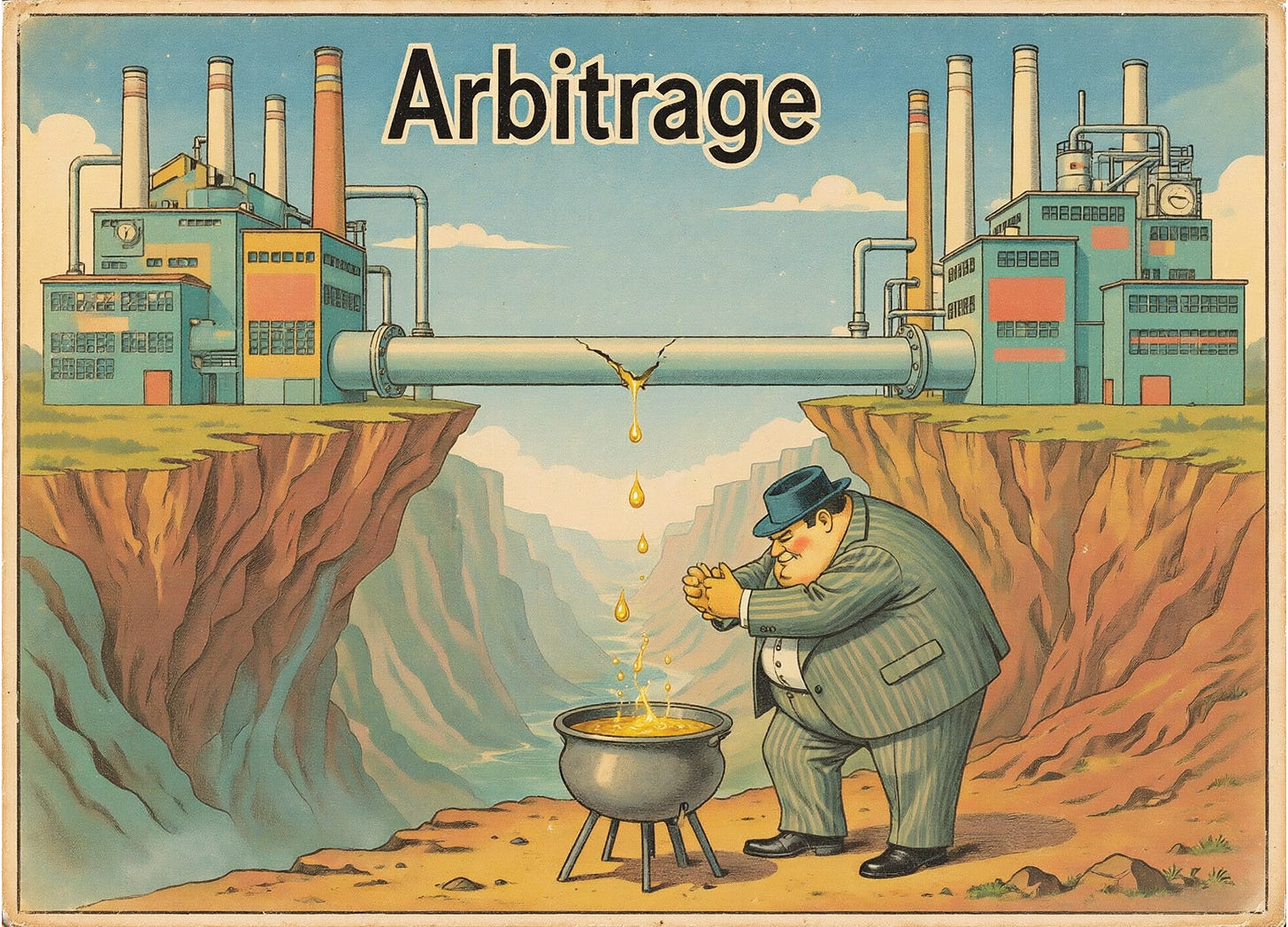
By Riggs D. Thermonucleon, with definitional restraint from Prof. Reeve Bellows, PhD (Probably), who insists this is “technically correct,” which is the most dangerous kind of correct
Your Executive Summary (Lucky YOU!)
What this is about:
Arbitrage is the practice of profiting from differences between systems—prices, rules, time, or information.
Why it matters:
It shows up everywhere in the modern economy, often framed as sophistication, but frequently functioning as extraction.
Key idea:
Arbitrage doesn’t fix systems. It profits from the gaps between them.
“Don’t use a five-dollar word when a fifty-cent word will do.”
— Mark Twain
There is a certain kind of word that enters the conversation and immediately raises the perceived intelligence of everyone using it.
“Arbitrage” is one of those words.
It has a clean, almost mathematical feel to it. Efficient. Neutral. The kind of thing that sounds like it belongs in a textbook or whispered across a glass conference table while someone gestures at a chart with quiet authority.
It suggests precision.
Discipline.
Control.
Which is impressive, because most of the time, what it actually describes is something much simpler.
The Original Version (Before It Got Fancy)
Arbitrage, in its purest form, is almost charming.
You find something priced differently in two places.
You buy it where it’s cheaper.
You sell it where it’s more expensive.
You keep the difference.
That’s it.
No innovation.
No transformation.
No value creation in the traditional sense.
Just… noticing a mismatch and acting on it.
You didn’t improve the system.
You found where it didn’t line up.
In small doses, this is harmless. Even useful. It helps align prices. It smooths out inefficiencies. It makes markets more consistent over time.
Everyone wins.
At least, that’s the theory.
The Upgrade (Where It Gets Interesting)
Then systems got more complicated.
Prices weren’t the only things that differed anymore.
Rules differed.
Labor costs differed.
Access to information differed.
Time horizons differed.
And suddenly, arbitrage had more room to operate.
A lot more room.
What Arbitrage Actually Looks Like Now
It rarely announces itself as arbitrage.
It shows up as:
“Strategic restructuring”
“Global optimization”
“Regulatory alignment”
Which is a polite way of saying:
We found a gap large enough to build a business on.
The Many Flavors of the Gap
Take labor.
If the same work can be done in two places at two very different costs, the system presents an opportunity. Move the work. Keep the difference.
That’s labor arbitrage.
It’s rarely described that way in polite conversation, but the mechanism is identical.
Or take regulation.
If one jurisdiction has stricter rules than another, you structure your operations to pass through the more accommodating one. Same activity, different oversight.
That’s regulatory arbitrage.
Again, not usually how it’s phrased.
But functionally identical.
Why does this feel… off?
Because somewhere along the way, the tone changed.
Arbitrage stopped being about smoothing inefficiencies.
And started being about finding them faster than anyone else—and getting paid before they close.
The incentive shifted from improving the system
to staying just ahead of its inconsistencies.
Cheating without cheating.
And inconsistencies, as it turns out, are plentiful.
📬 MID-ARTICLE ARBITRAGE
If you’ve ever heard something described as “a clever financial strategy” and thought, “That sounds like someone found a loophole,” you are already fluent in arbitrage.
If you’d like to keep building that fluency, consider subscribing to False Positive Labs.
We translate elegant terminology into operational reality. Paid subscribers get prettier translations.*
*Translations not actually prettier.
The Speed Problem
Modern arbitrage doesn’t just happen across space.
It happens across time.
Markets move. Information updates. Systems react—but not all at once.
If you can act faster than the adjustment…
You capture the gap.
This is why speed matters so much in modern finance.
Not because it creates better outcomes.
Because it allows earlier access to misalignment.
The gap doesn’t last forever.
But it lasts long enough.
The Information Layer
There’s also the matter of who knows what, and when.
Perfect information would eliminate many arbitrage opportunities.
Everyone would see the same thing.
Act at the same time.
Arrive at similar conclusions.
That’s not how the world works.
Information is uneven.
Access is uneven.
Interpretation is uneven.
Which means:
Understanding the system before it adjusts
is often more valuable than improving it.
The Part No One Says Out Loud
Arbitrage is often framed as intelligence.
Skill.
Sophistication.
And sometimes it is.
But just as often, it’s something else.
It’s proximity.
To capital.
To information.
To systems that others don’t fully see.
It’s easier to profit from a gap
when you’re already standing near it.
Which raises an uncomfortable question.
Not whether arbitrage exists.
But who gets to participate in it.
When It Becomes the Model
Here’s where things shift from interesting to structural. When arbitrage becomes widespread, it stops being an activity. It becomes a strategy.
And when it becomes a strategy, it starts shaping systems. Businesses are built not around creating value (as is so often the preferred excuse) but around finding where value is mispriced, misregulated, or misaligned.
Why fix the system
when you can monetize its imperfections?
That’s not a rhetorical question.
It’s a business model.
The Subtle Cost
Arbitrage doesn’t always break systems, but it can distort them.
It can:
Shift incentives away from production
Reward speed over stability
Encourage complexity over clarity
Because complexity creates gaps.
And gaps create opportunity.
Recognizing It in the Wild
You don’t need a finance degree to see arbitrage at work.
You just need to ask a simple question:
Where is the difference?
Difference in price.
Difference in rules.
Difference in timing.
Difference in knowledge.
If money is being made from that difference…
You’re probably looking at arbitrage. (And you’re probably not the one profiting from it!)
Final Thought
Arbitrage itself is not inherently good or bad.
It is simply a mechanism for interacting with systems as they exist.
But like any mechanism, it reflects incentives.
And right now, the incentives are clear.
Finding the gap is often more profitable
than closing it.
Which is why the concept matters.
Not as jargon.
But as a lens.
Because once you see the gaps…
You start to understand how the system really works.
Your TL;DR Moment
In plain English:
Arbitrage is profiting from differences between systems
It used to align markets, now often exploits gaps
It appears in labor, regulation, finance, and tech
Modern systems increasingly reward finding gaps over fixing them
Learn to See the Gaps
Arbitrage is just one example of how systems reward certain behaviors.
Riggs University’s “Business and Economics for the Bold and Brazen” breaks down how incentives shape outcomes.
Because once you see the gaps, you see the game.

Our Gap Is Grift
If this article made you reconsider the difference between “clever” and “extractive,” consider supporting False Positive Labs.
We promise to keep translating the language of systems into something usable.
Allow Us To Fill Your In-box Daily
Daily essays on business, economics, and the systems shaping modern life.
Subscribe before someone monetizes your attention span.
Globalize This Article
Know someone who uses the word “arbitrage” in conversation?
Send them this.
Let them explain it back to you.
The Grifter’s Glossary
For when the vocabulary gets suspiciously polished:
https://falsepositivelabs.substack.com/p/false-positive-labs-grifters-glossary
In Case You Didn’t Already Figure It Out…
This article is satire (supposedly) and commentary. It is not investment advice, legal guidance, or a recommendation to exploit inefficiencies in your immediate surroundings.
If you discover a gap, please use it responsibly.
If you would like to support the huge amounts of caffeine necessary to keep pieces like this coming, consider a small donation to the Koffee Klub:
