

Griftopedia: Optimization
The Art of Making Systems Perfectly Fragile
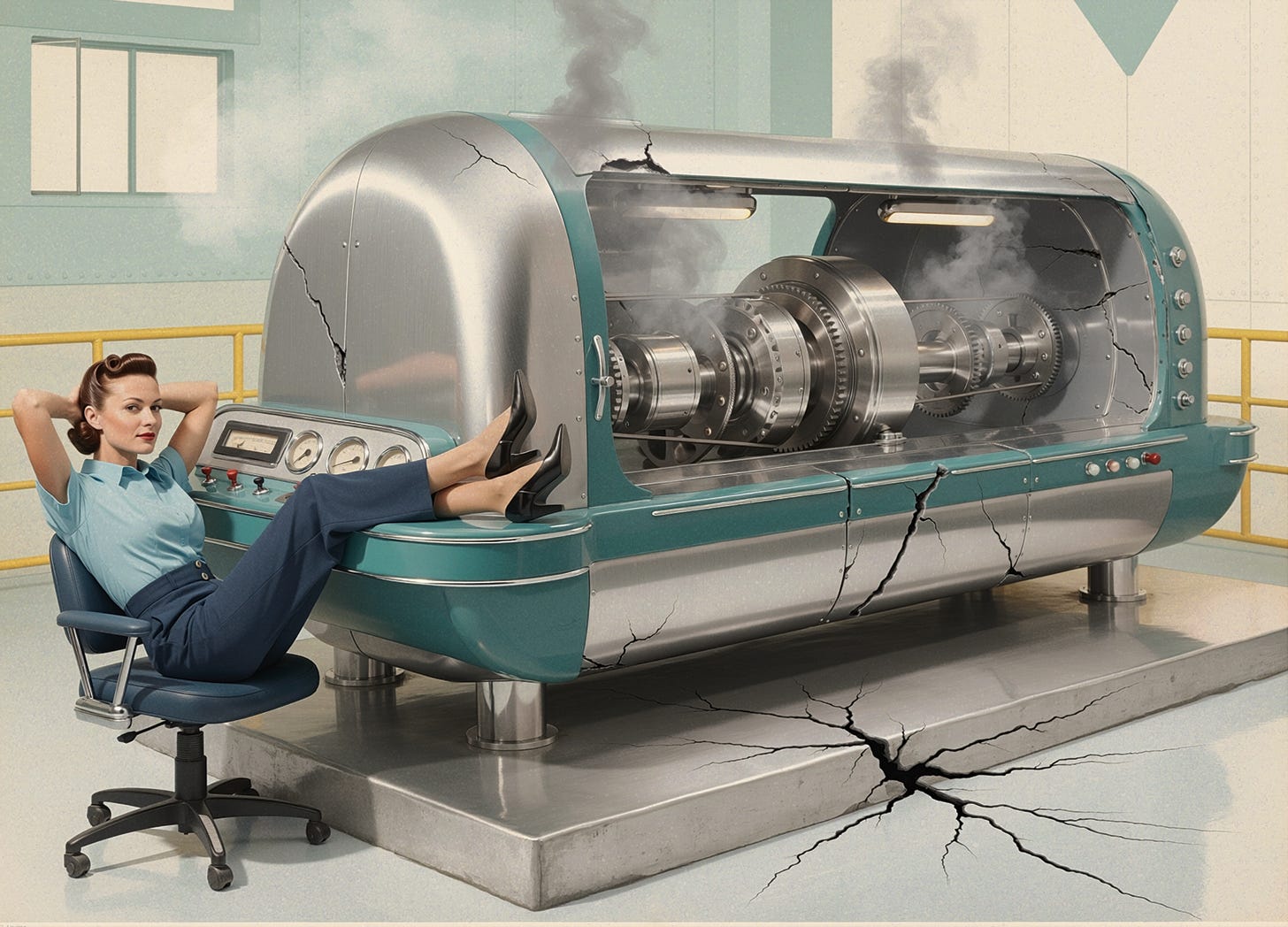
By Dr. Kevin “Kev” Blunt, Senior Analyst, Confusion Metrics™, with calibration input from Riggs D. Thermonucleon, who once optimized a sandwich and hasn’t been trusted since
Your Review in a Nutshell
What this is about:
Optimization is the process of improving a system for a specific goal—usually speed, cost, or efficiency.
Why it matters:
When systems optimize for narrow metrics, they often sacrifice resilience, quality, and long-term stability.
Key idea:
Optimization doesn’t eliminate problems—it redistributes them, often to places we don’t measure.
A Moment of Nostalgia
There was a time when systems were designed to work.
Not perfectly. Not efficiently. But reliably.
They had buffers. Redundancies. People whose job it was to notice when something felt… off. They were not elegant, but they were durable. Like an old truck that made unsettling noises but still got you home.
Then we discovered optimization.
And everything got better.
Faster systems. Lower costs. Leaner operations. More output with fewer inputs. The numbers improved, the charts went up and to the right, and somewhere in the distance, a consultant nodded approvingly.
It was, by every measurable standard, a success.
Which is why what happened next felt so confusing.
What Is Optimization, Exactly?
Optimization is defined as:
→ The process of improving a system to achieve maximum efficiency or effectiveness according to a specific metric.
That last part matters more than it looks.
A specific metric.
Because optimization is not about making everything better.
It is about making one thing better.
Relentlessly.
Why does everything feel slightly… off?
Because optimization improves what it measures—and quietly removes everything else.
Good. Fast. Cheap. (Pick two.)
–Sun Tzu “The Art of War”1
When a system is optimized for speed, it gets faster. When it’s optimized for cost, it gets cheaper. When it’s optimized for efficiency, it produces more with less.
But those gains don’t happen in isolation. They come from somewhere. Buffers are removed. Redundancies are cut. Margins for error shrink until they are less “margin” and more “suggestion.”
Optimization doesn’t break systems. It makes them precisely as strong as they need to be—and no stronger.
Which is impressive.
Right up until something unexpected happens.
The Lean Machine
Modern systems love the word “lean,” and not just in the “I’m not selling out, I’m leaning in,” way that most management-by-best-seller leaders like to cosplay their “humanity.”
No, we’re talking about the other “lean.”
Lean supply chains. Lean teams. Lean operations.
Lean, in this context, means efficient.
It also means there is very little extra capacity. Inventory is minimized. Staffing is optimized. Processes are streamlined to eliminate waste, which is excellent for cost control and less excellent for absorbing shocks.
If everything goes according to plan, a lean system is beautiful.
If something goes wrong, a lean system is… educational.
We removed the slack.
Then we discovered the slack was doing something.
The Invisible Trade
Here’s the part that rarely makes it into the quarterly report.
Optimization doesn’t eliminate problems.
It moves them.
Costs don’t disappear. They shift. Risk doesn’t vanish. It gets transferred. Work doesn’t go away. It gets redistributed, often to the people or parts of the system least equipped to handle it.
Customers wait longer. Workers stretch further. Systems operate closer to their limits.
And because these costs are distributed, they are harder to see.
The system looks efficient because the inefficiency has been outsourced.
Not removed.
Outsourced.
A BRIEF BREAK WITH (OR FOR) REALITY
If you enjoy discovering that the systems around you are functioning exactly as designed (which is both comforting and deeply concerning), consider subscribing to False Positive Labs.
We publish daily essays on business, economics, and the mechanics of modern life—so you can spot the pattern before it becomes your problem.
Tomorrow: incentives, behavior, and why everyone seems to be saying one thing and doing another.
When Metrics Become Reality
Realistically, optimization requires measurement.
And measurement requires simplification.
You pick a number. A target. A KPI2. Something that can be tracked, reported, and improved. And once that number is chosen, the system begins to orient itself around it.
This is where things get interesting. Because the metric becomes the goal, not the thing the metric was supposed to represent. Perhaps this is Schrodinger’s KPI3.
When a measure becomes a target, it stops being a good measure.
Which is how you end up with systems that are:
highly efficient on paper
increasingly fragile in practice
The numbers look great.
The experience feels… different.
How the System Actually Works
The logic is straightforward, even if the outcomes are not.
Incentive
Improve performance according to measurable metrics
Action
Optimize systems to maximize those metrics
Result
Faster, cheaper, more efficient operations
Hidden cost
Reduced resilience, quality, and ability to handle disruption
The Cascade Effect
Because optimized systems operate so close to their limits, small disruptions can have outsized effects.
A delay in one part of the system ripples outward. A shortage becomes a backlog. A failure becomes a cascade.
And suddenly, a system that looked perfectly stable reveals itself to be… delicately balanced.
Efficiency is stable until it isn’t.
And when it isn’t, it tends to fail all at once.
The Workforce Version
Optimization doesn’t stop at systems.
It applies to people.
Workforces are streamlined. Roles are consolidated. Teams are expected to do more with less. Which works, up to a point. Productivity increases. Costs decrease. Performance improves.
Until something changes.
Someone leaves. Demand spikes. A problem emerges that requires time, attention, or expertise that no longer exists in sufficient quantity.
At which point the system discovers it has optimized away its own flexibility.
We made everyone indispensable. Then we made them replaceable. Then we wondered why nothing worked the same.
The Part That’s Actually Good News
At this point, optimization can start to feel like a design flaw.
It’s not.
It’s a tool.
A powerful one.
The problem is not that we optimize. The problem is what we choose to optimize for.
Because systems can be designed to prioritize:
resilience
quality
human outcomes
long-term stability
Those things can be measured. They can be tracked. They can be optimized. They’re just… harder. Less immediate. Less tidy. Slightly more resistant to a clean quarterly narrative.
There is, however, a different way to approach this.
It’s called systemic design, and it starts with a slightly radical idea: that the parts of the system we don’t measure still matter. Instead of optimizing for a single outcome and discovering the consequences later, systemic design attempts to account for those consequences up front—mapping not just the intended results, but the side effects, dependencies, and trade-offs that come with them.
In other words, it treats externalities not as unfortunate surprises, but as design inputs.
This approach is slower. It’s messier. It doesn’t produce clean, single-number success metrics that fit neatly into a quarterly report. But it does something optimization alone cannot do.
It builds systems that can absorb stress without collapsing.
Optimization asks, “How fast can this go?”
Systemic design asks, “What happens when it breaks?”
And more importantly:
“Who pays for it when it does?”
That shift—from measuring performance to understanding impact—is where better systems begin. Not perfect systems. Not frictionless ones. But systems that are at least honest about the trade-offs they create.
And honesty, as it turns out, scales surprisingly well.
Final Thought
The system isn’t broken.
It’s optimized.
For speed.
For cost.
For efficiency.
And those are not bad goals.
They’re just incomplete ones.
Optimization doesn’t tell you what matters.
It tells you what you decided to measure.
Which means the real question isn’t whether we should optimize.
It’s whether we’re optimizing the right things.
Because once you understand that…
You start to see the system differently.
And once you see it differently—
You can start to design it differently.
TL;DR
In plain English:
Optimization improves systems based on specific metrics
It removes anything that isn’t measured (like resilience or quality)
Problems don’t disappear—they get shifted elsewhere
Systems can be redesigned to optimize for better outcomes
Learn the System Behind the System
Optimization, incentives, and system design shape everything from your job to global markets.
Riggs University’s “Business and Economics for the Bold and Brazen” explains how these forces actually work.
Because once you understand the system, you stop confusing performance with outcomes.

Your Gift Supports This Grift
False Positive Labs runs on readers who enjoy realizing that things are working exactly as designed (even when that’s the problem).
If this article made you rethink efficiency, consider supporting the project.
Get The Plain English Directly To Your In-box
We publish daily essays on business, economics, and the systems shaping modern life.
Give The Gift Of Insight
If this article made you see something differently, share it with someone else.
Friends, coworkers, family members, and anyone currently “streamlining processes” are all excellent candidates.
The Grifter’s Glossary
Economic language often hides simple truths.
The Grifter’s Glossary translates those ideas into plain English—with occasional sarcasm.
Explore it here:
https://falsepositivelabs.substack.com/p/false-positive-labs-grifters-glossary
ICYMI…
This article is satire and commentary. It is not operational advice, consulting guidance, or instructions to redesign your company during a coffee break.
If you attempt to optimize your life entirely, please leave room for error.
Preferably on purpose.
Help keep Riggs Caffeinated:

Sun Tzu’s The Art of War: An ancient Chinese military text (circa 5th century BCE) focused on strategy, preparation, and winning without direct conflict. Frequently quoted in business contexts by people who have never commanded an army but have, at some point, optimized a spreadsheet. Its core lesson—that understanding systems, incentives, and positioning matters more than brute force—remains surprisingly relevant, even when misapplied in quarterly planning meetings.
KPI (Key Performance Indicator): A measurable value used to evaluate how effectively a person, team, or organization is achieving a specific objective. In theory, KPIs help focus effort. In practice, they often become the objective itself, resulting in teams hitting their numbers perfectly while missing the point entirely.
Schrödinger’s Cat (Applied: “Schrödinger’s KPI”):
A famous thought experiment from quantum physics in which a cat is simultaneously alive and dead until observed. In business, a “Schrödinger’s KPI” is a metric that both represents success and distorts it at the same time. The system appears to be working because the number improves, even as the underlying reality becomes increasingly disconnected from what the number was meant to measure.