

Griftopedia: Trust
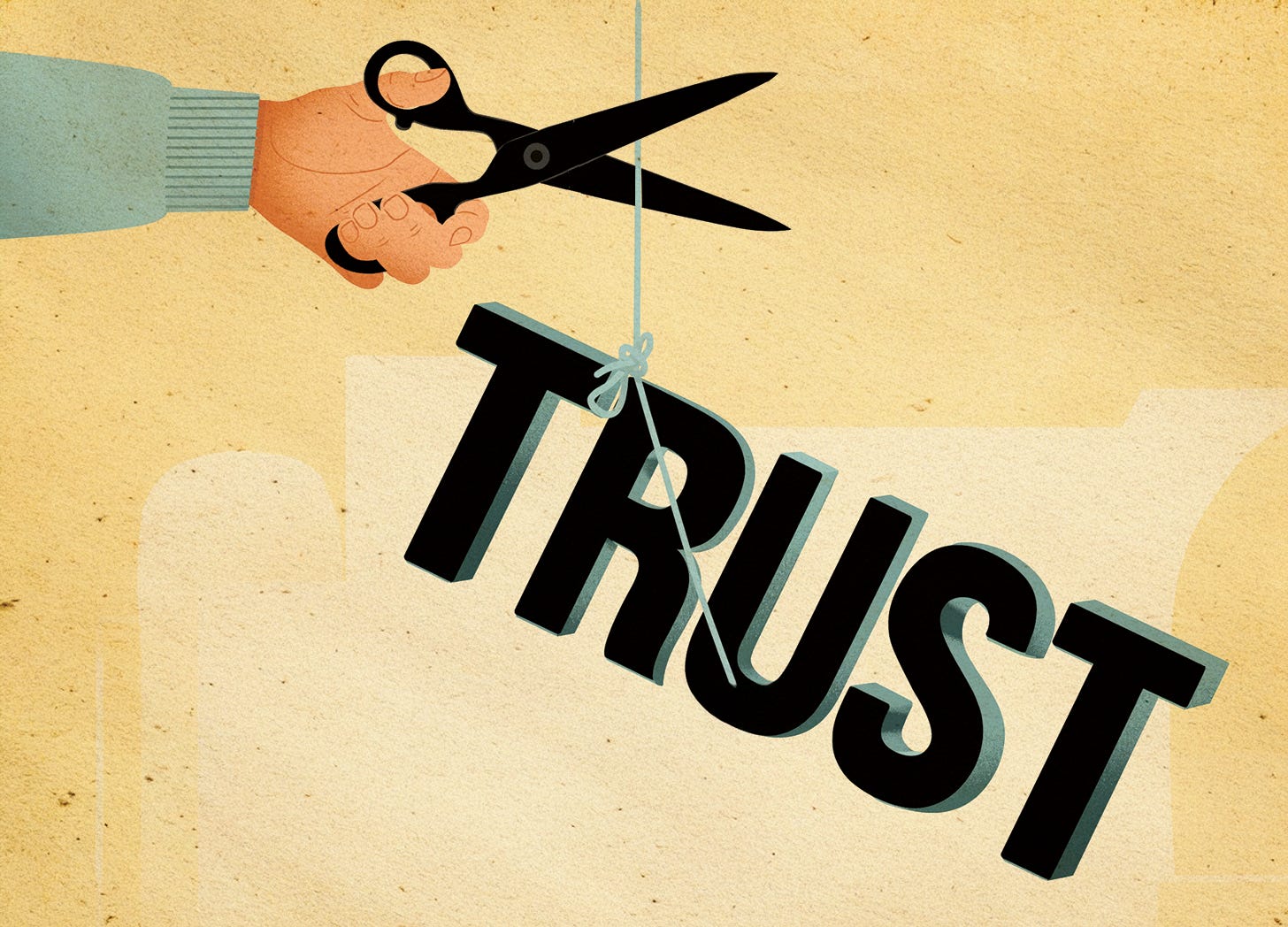
The Most Valuable Asset Modern Systems Keep Setting on Fire
By Prof. Reeve Bellows, PhD (Probably), and Riggs D. Thermonucleon, MBA (Maladaptive Behavioral Architecture)
The Rundown
What this is about:
Trust is the invisible social infrastructure that allows institutions, economies, and societies to function.
Why it matters:
When trust erodes, systems become slower, more fragile, more expensive, and more vulnerable to corruption, extremism, and collapse.
Key idea:
Civilizations do not survive on efficiency alone. They survive because enough people still believe the system is broadly legitimate.
The Unifying Effect of Convention
There is a comforting belief that civilization is held together by laws.
Constitutions.
Courts.
Regulations.
Contracts.
Formal procedures.
And yes, those things matter.
But underneath all of them—quietly supporting the entire structure like the world’s least appreciated load-bearing wall—is something far more fragile:
Trust.
Trust that elections broadly reflect reality.
Trust that contracts mean something.
Trust that institutions are not entirely fake.
Trust that the food probably won’t poison you.
Trust that bridges will continue bridge-ing.
Trust that the doctor is not simply a pharmaceutical subscription influencer wearing a stethoscope.
Modern society runs on an astonishing amount of invisible faith. And lately, that faith has begun developing… hairline fractures.
Not dramatic ones at first.
Just little things.
Customer service systems that trap you in chatbot purgatory.
Corporations announcing “people-first values” moments before layoffs.
Media outlets that increasingly sound like risk-managed branding departments.
Political systems that somehow raise billions of dollars annually while repeatedly acting shocked that citizens feel unheard, unsupported and precarious.
Social platforms optimizing emotional instability because it performs well against quarterly advertising targets.
Individually, these seem manageable.
Collectively, they create something much larger:
A legitimacy problem.
And legitimacy, unfortunately, is one of those things you only realize you needed after it starts disappearing.
What Is Trust?
Trust is defined as:
The belief that people, institutions, or systems will behave in reasonably reliable, honest, and predictable ways.
That sounds simple.
It is not.
Because trust is not merely emotional.
It is infrastructural.
The economy depends on it.
Democracy depends on it.
Markets depend on it.
Relationships depend on it.
Even money itself is basically a socially agreed-upon hallucination supported by collective confidence and several heavily armed government agencies.
Once trust weakens, systems become dramatically more expensive to operate.
You need:
more lawyers,
more verification,
more compliance,
more surveillance,
more security,
more bureaucracy,
more public relations,
more brand management,
more “strategic communications.”
In other words:
Trust is cheap.
Mistrust is unbelievably expensive.
Which makes modern society’s habit of constantly setting trust on fire particularly impressive.
Looking Back (Over Our Collective Shoulder)
There was a time when institutions at least attempted to appear restrained.
Corporations feared public scandal.
News organizations protected reputations carefully.
Political corruption generally required the decency to occur quietly in hotel rooms instead of livestreaming itself directly into social media feeds between energy drink sponsorships.
Now the operating philosophy increasingly feels closer to:
“What are you going to do about it?”
And to be fair, that question lands differently once people begin feeling powerless.
Because the erosion of trust is not happening in isolation.
It is happening alongside:
wealth concentration,
platform consolidation,
algorithmic media systems,
AI-generated information sludge,
institutional capture,
regulatory paralysis,
and increasingly visible forms of elite impunity.
That combination produces a dangerous psychological effect. People stop believing systems are designed to serve them. And once that belief weakens, cynicism spreads extremely quickly.
Cyntelligence
The truly dangerous part is that cynicism initially feels intelligent.
It feels perceptive.
Sophisticated.
Protective.
“Oh, you still trust institutions? That’s adorable.”
And certainly, skepticism is healthy. Blind trust is how you end up investing retirement savings into cryptocurrency projects named after amphibians.
But there is a difference between skepticism and total legitimacy collapse.
Skepticism asks questions.
Legitimacy collapse concludes:
“Nothing matters.”
“Everyone is corrupt.”
”Both sides do it.”
“All systems are fake.”
“There is no truth.”
“There is only power.”
Once populations arrive there, societies become extraordinarily vulnerable to manipulation because exhausted people will often trade democratic complexity for emotional certainty.
History contains several… unfortunate examples.
The Revolution Is Not Only Being Televised, It Is Being Monetized
One of the more fascinating aspects of modern trust erosion is how many institutions actively participate in their own delegitimization.
Media organizations optimize for engagement while lamenting polarization.
Corporations aggressively pursue short-term shareholder gains while expressing confusion about collapsing brand loyalty.
Social media platforms amplify outrage because outrage performs well algorithmically, then commission wellness reports examining why users appear emotionally unwell.
It is the systems-design equivalent of setting your kitchen on fire and then publishing a white paper titled:
“Emerging Trends in Elevated Indoor Temperatures.”
Even universities—historically among the more trusted institutions in society—now increasingly behave like anxious hedge funds wearing cardigans.
Students are treated simultaneously as:
customers,
metrics,
future donors,
brand extensions,
and debt-powered revenue streams.
Which may explain why many young people increasingly approach institutional messaging the way medieval villagers approached wandering alchemists.
Cautiously.
With torches nearby.
Meanwhile, the internet completed the final stage of informational flattening.
For most of modern history, information passed through filters:
editors,
fact-checkers,
professional standards,
institutional reputations,
legal exposure.
Those systems were imperfect.
Sometimes biased.
Occasionally catastrophic.
But they created friction.
Now friction is gone.
A Pulitzer-winning investigation competes on the same feed as:
a conspiracy livestream,
an AI-generated fake clip,
a cryptocurrency guru explaining masculinity,
and a man named “PatriotWolf1776” confidently diagnosing global economics from inside a pickup truck.
And because modern algorithms optimize for engagement—not truth—the most emotionally stimulating content often spreads furthest.
Which means the modern information ecosystem increasingly rewards:
certainty over accuracy,
confidence over expertise,
identity over evidence,
and performance over substance.
This is not an ideal operating environment for democratic civilization.
Or human nervous systems.
Now, at this point, it would be easy to conclude the situation is hopeless.
That civilization is simply dissolving into a giant sludge pit of propaganda, corruption, AI-generated nonsense, and emotionally exhausted citizens screaming at each other through algorithmically weaponized rectangular devices.
But here’s the interesting thing:
Trust can erode quickly.
It can also rebuild surprisingly locally.
Because trust does not only exist at institutional scale.
It exists interpersonally.
Communally.
Incrementally.
People still trust:
friends,
neighbors,
local organizations,
small communities,
people who consistently behave honestly,
people willing to admit uncertainty,
people whose actions align with their stated values.
Which points toward something important:
Legitimacy is not restored through branding campaigns.
It is restored through demonstrated behavior over time.
Slowly.
Annoyingly.
Humanly.
Which is unfortunate because modern systems strongly prefer quarterly solutions to generational problems.
And yet…
Even now, people continue trying to build trustworthy things.
Independent journalism.
Local communities.
Ethical businesses.
Mutual aid networks.
Transparent institutions.
Open-source projects.
Real relationships.
Actual expertise.
These efforts rarely dominate headlines because trust-building is not emotionally explosive enough to trend.
Chaos scales faster.
But durable systems are rarely built from chaos alone.
They are built from repeated demonstrations that:
honesty matters,
competence matters,
accountability matters,
and people are still capable of cooperating without immediately monetizing one another into dust.
Which means the fight against legitimacy collapse is not purely political, but behavioral, cultural, institutional, personal.
It involves rewarding honesty instead of spectacle.
Competence instead of confidence theater.
Reality instead of emotionally satisfying fiction.
And yes, occasionally touching grass.
Because despite appearances, most people are not actually asking for perfection.
They are asking for signs that the systems surrounding them are still grounded in something more meaningful than engagement metrics, shareholder extraction, and elite self-preservation.
They want to believe:
the rules still matter,
the future still exists,
and the people operating major institutions are not simply improvising civilization one quarterly earnings call at a time.
Which, admittedly, is becoming a difficult sell.
Still.
Trust remains one of the few forms of infrastructure that cannot simply be automated, financialized, or brute-forced into existence.
It must be earned.
Repeatedly renewed and reinforced.
And once enough people stop believing that process matters, even very powerful systems begin getting shaky in ways no amount of branding can fully conceal.
Learn The System, Beat The System
What better way to dismantle the system than to understand how it works from the inside? Learn the details at Riggs University with our course, Business 101: Business and Economics for the Bold and Brazen. Enrollment open.

Subscribe to False Positive Labs
If you enjoy darkly humorous systems analysis with “questionable authorship”, subscribe to False Positive Labs.
We examine:
economics,
technology,
media,
incentives,
institutional decay,
and the increasingly strange experience of being alive during late-stage optimization culture.
Free subscriptions are welcome.
Paid subscriptions help fund:
research,
writing,
server costs,
and whatever emotional recovery program Riggs currently claims qualifies as “business expenses.”
Share This With Someone Who Still Says “The System Is Working Fine”
Nothing says friendship quite like forwarding a 4,000-word satirical essay about collapsing institutional legitimacy.
Spread responsibly.
The Truth (…As We See It)
False Positive Labs is a satirical publication focused on systems analysis, economics, media, technology, and institutional behavior.
Any resemblance to actual functioning governance structures is purely coincidental and increasingly statistically concerning.
The Grifter’s Glossary
Confused by terms like:
legitimacy,
incentive structures,
algorithmic amplification,
institutional capture,
and “attention economy psychosis”?
Visit the official False Positive Labs Grifter’s Glossary:

If you’d like to contribute to the False Positive Labs mission, caffeine is always appreciated…
