

Same Game, Different Rulebook
How Companies Shop for Laws Like They’re Booking Flights
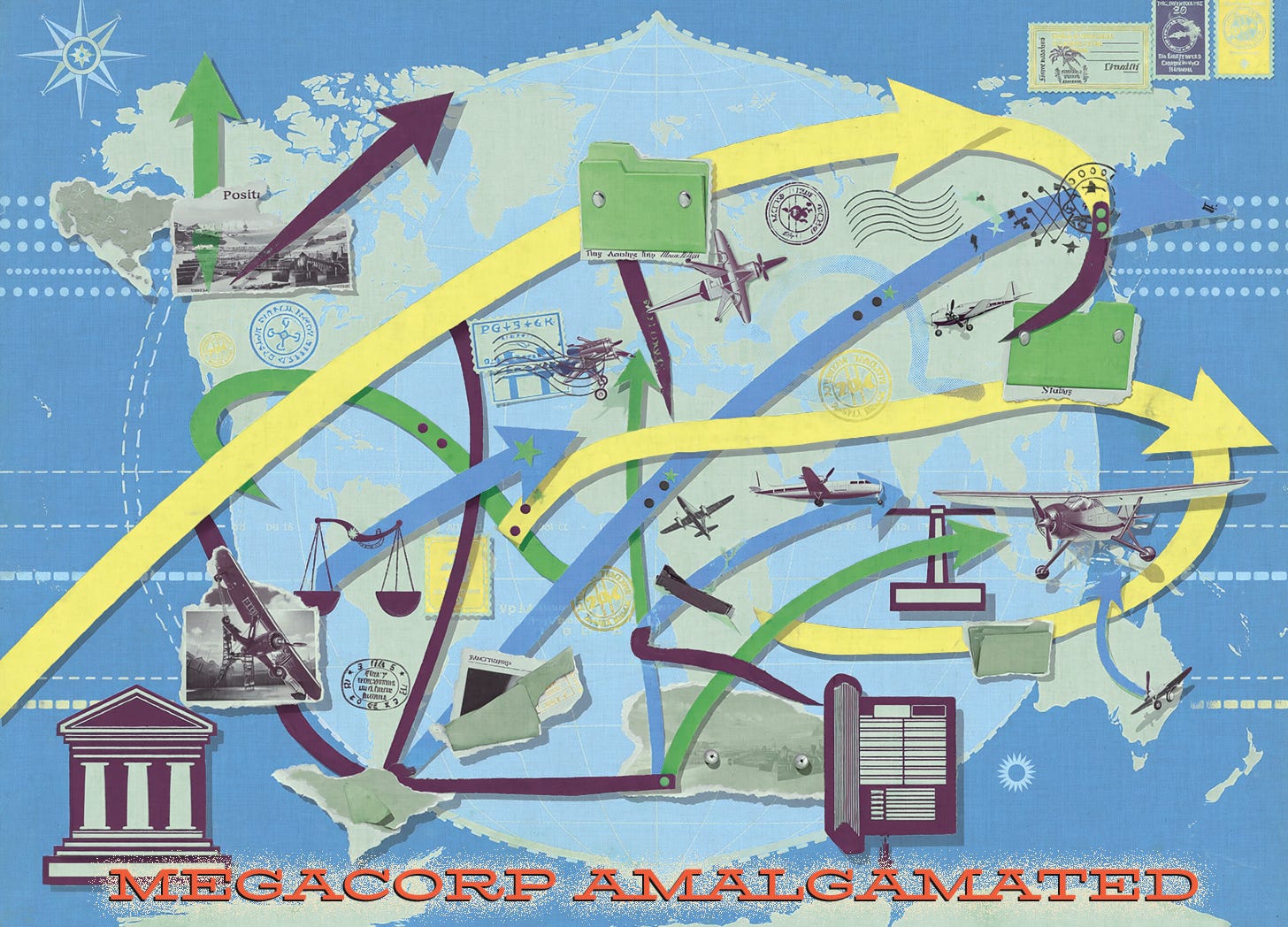
By Riggs D. Thermonucleon, with jurisdictional mapping by Prof. Reeve Bellows, PhD (Probably), who insists that “compliance” and “creativity” are not synonyms but understands why people get confused
The Fix is In
There’s a comforting idea that rules are fixed.
You operate in a country.
That country has laws.
You follow them.
Simple.
Linear.
Adorable.
The Part Where It Gets Complicated
Now imagine you’re not a person.
You’re a company1.
Not a small one. A large one. One with operations in multiple regions, access to legal expertise, and a very strong interest in “optimizing” outcomes.
Suddenly, “the rules” are not a single set.
They are a menu.
Different jurisdictions offer different conditions.
Tax rates vary.
Labor laws differ.
Reporting requirements shift.
And you begin to notice something.
The same activity can be treated very differently depending on where it’s routed.
What Is Regulatory Arbitrage?
Regulatory arbitrage is defined as:
→ The practice of structuring activities to take advantage of differences in laws, regulations, or enforcement across jurisdictions.
That’s the formal version.
The working version is simpler:
Follow the rules… just not necessarily all in the same place.
The Geography of Convenience
Let’s say you have a business that operates globally.
You can:
Incorporate in one country.
Report revenue in another.
Hold intellectual property somewhere else entirely.
Each decision is technically compliant.
Each step is legal within its context.
Put together, it forms a structure that looks less like a company…
…and more like a carefully routed itinerary.
Welcome to the economy, where your corporate headquarters, your tax obligations, and your actual operations may all be experiencing different climates.
The Airline Ticket Analogy
If you’ve ever searched for flights, you’ve seen this dynamic.
The same destination can have wildly different prices depending on routing, timing, and the specific path you take to get there.
Companies approach regulation in much the same way.
Not “What are the rules?”
But:
“Where are the rules most favorable for each part of what we do?”
It’s not avoidance.
It’s optimization.
At least, that’s the language.
Why This Happens
Because, once again, incentives.
If reducing regulatory burden improves margins—and if those improvements are rewarded—then companies will explore every available pathway to achieve that outcome.
Not because they are uniquely clever.
Because the system allows it.
When systems don’t align,
the gaps become pathways.
The Complexity Advantage
There’s another layer here that doesn’t get discussed as often.
Complexity itself becomes an advantage.
If the system is difficult to understand, it becomes easier to navigate strategically.
Those with the resources to interpret and structure around that complexity gain access to opportunities that are invisible—or inaccessible—to others (a.k.a. you).
It’s not just about knowing the rules.
It’s about knowing how they interact.
And that interaction is where arbitrage lives.
A BRIEF NOTE FROM ANOTHER JURISDICTION
If you’ve ever read about a company “legally minimizing its tax exposure” and thought, “That sounds like a very polite way of saying something else,” you are not alone.
If you’d like to understand how these structures actually work, consider subscribing to False Positive Labs.
We translate economic strategy into plain English—and occasionally into raised eyebrows. Air-sickness bags not included.
The Perfectly Legal Gray Area
One of the more fascinating aspects of regulatory arbitrage is that it often exists entirely within the bounds of legality.
No rules are broken.
No laws are violated.
Everything checks out.
And yet, the outcome feels… misaligned.
Because legality and intent are not always the same thing.
A system can be followed precisely
and still produce results it wasn’t designed to produce.
This is not a loophole.
It’s a consequence.
The Race Condition
Once one company begins optimizing this way, others follow. Not out of malice, but out of necessity. If your competitors are reducing costs through regulatory arbitrage, maintaining a higher-cost structure becomes difficult to justify. (Remember that corporations have a “fiduciary responsibility to shareholders” that they must abide by, an inconvenient truth.)
And so the pattern spreads.
Jurisdictions compete.
Rules adapt.
Structures evolve.
It’s not a single decision.
It’s a system response.
What Gets Left Behind
Every optimization has a cost. In this case, the cost is often diffused.
Tax bases shift.
Regulatory intent weakens.
Public systems lose alignment with private activity.
None of this happens in a single moment.
It accumulates.
Quietly.
Recognizing It
You don’t need to follow every legal structure to see the pattern. Just look for the signals.
A company operating everywhere… but paying taxes somewhere very specific (and sometimes not even in your country).
Revenue flowing through locations that don’t quite match where value is created.
Language that emphasizes compliance without explaining structure.
When the path becomes more important than the place,
you’re probably looking at arbitrage.
The Design Question
At some point, this stops being about individual companies, but rather a question about systems. If rules differ, arbitrage will exist. If incentives reward it, arbitrage will expand.
The question is not whether it happens, it’s how much of the system we want to operate this way.
Something To Consider
Regulatory arbitrage is not a bug.
It’s a reflection of how complex systems interact. It shows you where rules don’t align, where incentives diverge, and where outcomes begin to drift from intent.
The system is being followed.
Just not in the way it was imagined.
And once you see that…
You start to understand why things feel both structured and slightly off at the same time.
Learn How Systems Interact
Rules, incentives, and structures don’t operate in isolation—they interact.
Riggs University’s “Business and Economics for the Bold and Brazen” explores how those interactions shape real-world outcomes.
Because once you see the connections, the patterns become clearer.

Our Rules Are Bent
If this article made you rethink the difference between “legal” and “aligned,” consider supporting False Positive Labs.
We promise to keep asking questions that systems would prefer remain rhetorical.
From Our Press To Your In-box Daily
Daily essays on business, economics, and the systems shaping modern life.
Subscribe before the routing gets more complicated.
*Not all mollusks.
Put A Kink In Someone’s Day
Know someone who thinks regulation is straightforward?
Send them this.
The Grifter’s Glossary
For when the language gets… carefully constructed:
https://falsepositivelabs.substack.com/p/false-positive-labs-grifters-glossary
Disclaimer-like Notification
(Jurisdictional Edition)
This article is satire and commentary, or so we are told. It is not legal advice, tax strategy, or guidance on structuring multinational entities.
If you attempt to optimize across jurisdictions, please consult someone with a significantly larger legal budget.
If you’ve ever wondered where deranged ramblings such as the preceding article come from, it’s caffeine. Lots and lots of caffeine.

Mitt Romney’s protestations not withstanding, corporations and companies are NOT people. They are “legal entities” assigned people-like characteristics by legislation to make them easier to deal with, despite their surly and brutish personalities. They are not human, even if they are a bunch of jerks.